Francis Hutcheson: The Forgotten Scots-Irish Architect of American Independence
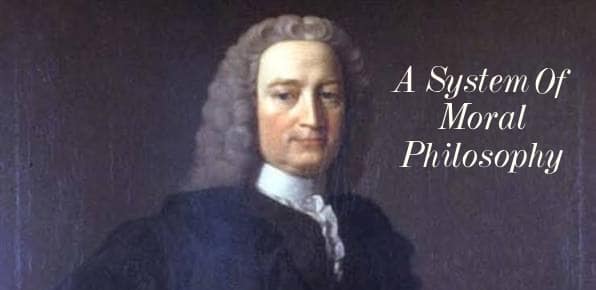
When we trace the intellectual roots of American democracy, we tend to stop at Locke, Montesquieu, or Jefferson’s pen. But before any of them shaped the Revolution, a Presbyterian minister’s son from County Down was already teaching young men in Glasgow that ordinary people possessed, within themselves, the moral equipment to govern their own lives — and by extension, to govern themselves politically.
That man was Francis Hutcheson, and he deserves to be remembered as one of the true intellectual heavyweights behind the ideals of modern democracy.
A Radical Idea: Moral Sense
Hutcheson’s central philosophical claim was deceptively simple: human beings are born with an innate “moral sense,” an internal faculty that allows them to distinguish right from wrong without needing a king, a bishop, or a court to instruct them. This was not a small theological footnote — it was a direct challenge to the doctrine of the Divine Right of Kings, which held that authority flowed downward from God through the monarch and was not the people’s to question or judge.
If ordinary men and women could perceive justice and virtue on their own, then legitimate government had to be grounded in the consent and moral judgment of the governed, not imposed from above. This was the philosophical seed of self-rule. Hutcheson made the political implications explicit, arguing that societies should be organized for what he called the greatest happiness of the greatest numbers — a phrase and principle that would echo through Enlightenment political thought for the rest of the century.
The Ulster Connection
Hutcheson himself was born near Saintfield, County Down, in the north of Ireland, and his ideas took root with particular force among the Ulster-Scots Presbyterian community there. As professor of moral philosophy at Glasgow from 1729 to 1746, he trained a generation of students from that community — men shaped by a Presbyterian tradition already suspicious of unchecked authority, and now newly armed with a philosophical case for it.
Chief among them was Francis Alison, born near Letterkenny in Donegal, who studied under Hutcheson before emigrating to Pennsylvania in 1735. Alison founded a classical academy in New London, in Chester County, built explicitly on Hutcheson’s moral philosophy curriculum. It was a remarkably small school with an outsized legacy: of its first class of just ten students, three — George Read, Thomas McKean, and James Smith — went on to sign the Declaration of Independence.
Alison didn’t stop there. He carried Hutcheson’s curriculum to the Academy of Philadelphia, later the University of Pennsylvania, becoming one of colonial America’s most respected classical scholars and, in Benjamin Franklin’s words, a man of great learning. Through correspondence with Hutcheson himself, Alison kept refining the texts and ideas he passed on to students who would soon be arguing for independence from Britain.
Seeding a Revolution
What Alison and his fellow Ulster emigrants planted in Pennsylvania was more than a curriculum — it was a disposition. Students raised on Hutcheson’s teaching learned that political legitimacy rested on the moral judgment of the people, not the will of a distant sovereign. By the 1760s and 1770s, as tensions with the Crown escalated, this was no longer an academic position. Alison himself warned that Parliament’s attempts to yoke the colonies would ultimately destroy the yoker as much as the yoked.
It is not an exaggeration to say that when the signers of the Declaration asserted that governments derive their just powers from the consent of the governed, they were articulating, in political form, an idea Francis Hutcheson had already worked out in moral philosophy decades earlier — carried across the Atlantic by his students, and planted in the soil of a new republic.